
Beyond Israel
Assessing Iran’s Long-Range Threat to Europe

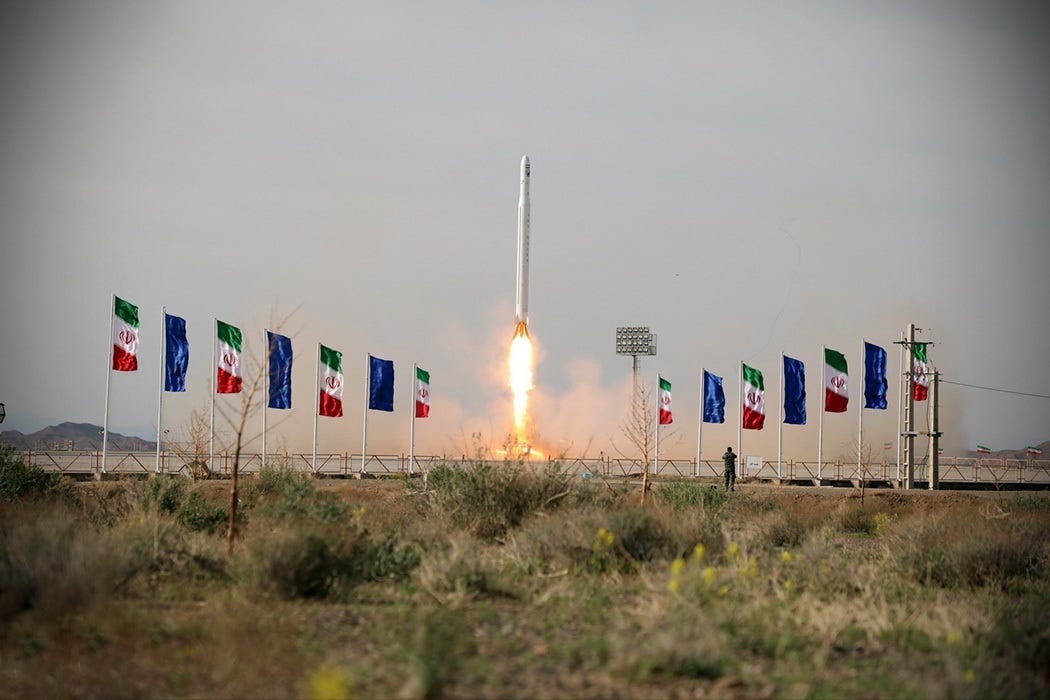
The latest escalation between Iran, the United States and Washington’s regional allies has been accompanied by increasingly explicit Iranian threats against European states. On 23 July, after noting that the US had used B-1 Lancer bombers operating from RAF Fairford in the United Kingdom, the IRGC warned that such operations could make the UK a legitimate military target. Only days later, following a Ukrainian long-range drone strike against a vessel in the Caspian Sea reportedly carrying arms to Ukraine, Iran’s foreign minister vowed that the attack would not go unanswered. Iran reportedly considered striking a Ukrainian port before backing off.
These threats follow more aggressive action against European targets during the 2026 conflict, in which Iranian missiles and drones struck German, Italian and French military installations in the Middle East. While some of these strikes might have been the result of co-location with US military assets, others, like the strike on France’s Camp de la Paix in Abu Dhabi, were very likely deliberate. Iran’s Lebanese proxy Hezbollah also launched drone attacks against RAF Akrotiri in Cyprus, marking the first conventional military attack on a target in Europe by Iran’s wider Axis of Resistance.
Within continental Europe, Iran continued its longstanding reliance on deniable asymmetric operations. These included arson attacks against Jewish and Iranian opposition targets, which the British Home Office assessed to have been directed by the IRGC Quds Force and carried out through a local proxy.
Whether a more direct conventional military threat to continental Europe ultimately materialises will depend on both the evolving reach of Iran’s missile and UAV capabilities and the intentions of a regime transformed by the 2026 conflict.
Eastern Europe in the Crosshairs
The range profile of Iran’s long-range missile arsenal has been shaped by both Tehran’s former self-imposed 2,000-kilometre range limit and the roughly 1,000 kilometres separating Iran’s western border from Israel. Within this range envelope, Iran has developed several missile and UAV systems capable of reaching targets in Ukraine, Romania, Bulgaria and Greece.
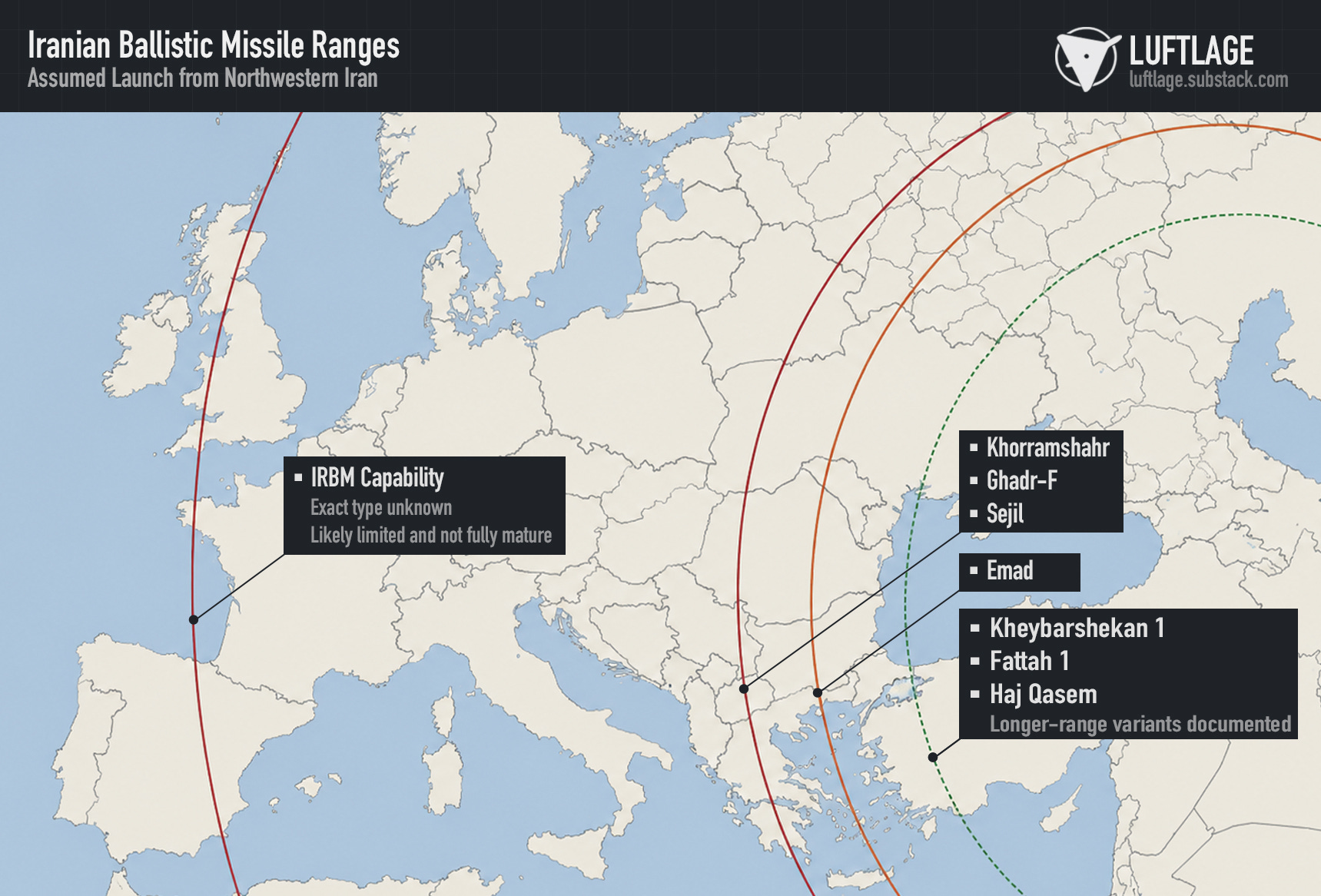
Iran’s liquid-propellant Ghadr-F and Khorramshahr missiles, as well as the solid-propellant Sejjil, have ranges of approximately 2,000 km, placing much of these countries within reach. None of these systems, however, is equipped with terminal guidance, severely limiting their accuracy. The Emad, a terminally guided derivative of the Ghadr, would enable more precise strikes, while its range of approximately 1,750 km would remain sufficient to reach Kyiv and Bucharest.
Iran’s new generation of comparatively affordable, precision-guided solid-propellant missiles presents a more complex picture. The declared ranges of the Kheybarshekan-1 and Fattah-1, at 1,300-1,400 km, would restrict them largely to targets in Cyprus and along Ukraine’s Black Sea coast. Their reach could, however, be extended through changes to payload and flight trajectory. Yemen’s Houthis appear to have employed a derivative of the Fattah-1 over distances of approximately 1,900 km. The range of the Kheybarshekan-2 remains unknown.
One-way attack UAVs offer another potential means of striking European targets. Both the IRGC’s Shahed-136 and the Artesh’s Arash-2 are reported to have maximum ranges of approximately 2,000 km. Their effective reach would, however, be reduced by the indirect routing required to improve survivability. Any attack on targets in Europe would also require the UAVs to transit the airspace of neighbouring states, presenting an additional operational and political constraint.
Cruise missiles represent another means of reaching European targets, albeit with significant operational limitations. Iran operates the Paveh/351 land-attack cruise missile, with a reported range of approximately 1,750 km. Variants with extended ranges are known to exist and have been supplied to the Houthis, while Iran has also developed anti-ship derivatives of the system. However, Iran’s combat employment of these missiles in 2024 and 2026 appears to have been largely unsuccessful for reasons that remain unclear. Iran’s attempt to reverse-engineer the long-range Soviet Kh-55 cruise missile also seems to have, at least partially, failed. Contrary to widespread perceptions, Iran’s Kh-55 copy, the Soumar, does not appear to have entered service, with only a shorter-range anti-ship variant being deployed.
Long-Range Hedging
At ranges beyond 3,000 km, which would be required to strike targets in Central and Western Europe, conventional OWA-UAVs and cruise missiles cease to be viable, leaving ballistic missiles as Iran’s only potential means of attack.
At some point during the 2000s, Iran’s Supreme Leader, Ali Khamenei, imposed a voluntary 2,000 km range limit on the country’s missile developers. The decision, reportedly opposed by parts of the security establishment, appears to have been intended to avoid further alienating European states. Tehran subsequently incorporated the limit into its diplomatic bargaining, repeatedly threatening to abandon it should Europe adopt a more hostile posture.
At the same time, the range limit was less categorical than Iranian officials often suggested. Tehran appears to have refrained from developing missiles with declared ranges exceeding 2,000 km while continuing to advance many of the underlying technologies required for longer-range systems, thereby avoiding a formal breach of the restriction. In this respect, the approach resembled Iran’s strategy of nuclear hedging, under which it acquired and matured much of the capability needed to produce a weapon while stopping short of building one. Some Iranian accounts suggest that, in the missile sphere, this policy may also have represented an attempt to balance competing interests within the regime.
Iran’s Super Heavy MRBM
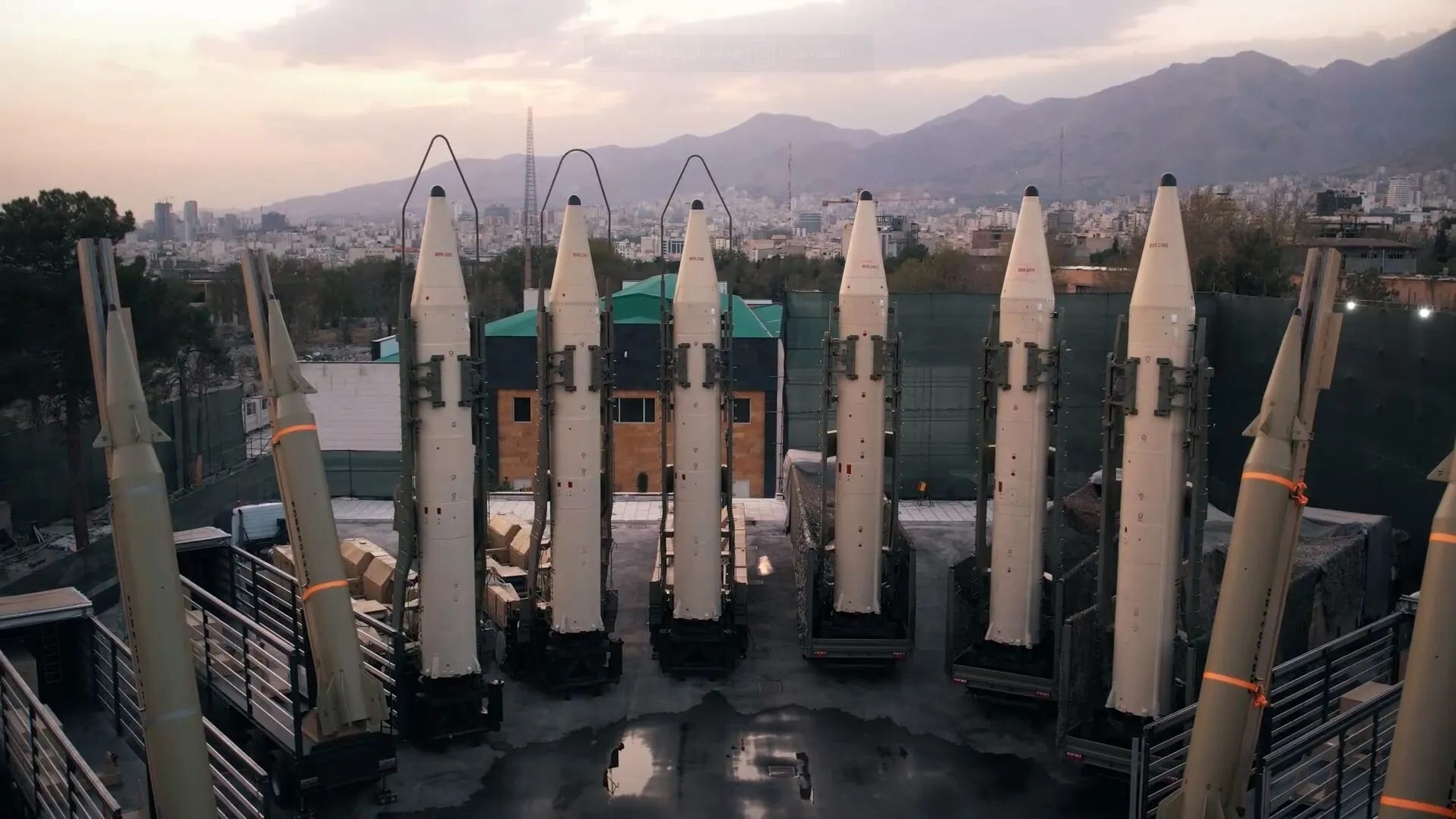
The first noteworthy system in this regard is Iran’s Khorramshahr medium-range ballistic missile (MRBM). Derived from the North Korean Musudan, itself a localised version of the Soviet R-27 (SS-N-6 Serb), the Khorramshahr uses a more advanced liquid-propellant technology than the remainder of Iran’s arsenal, whose propulsion traces back to the Scud lineage. Unlike North Korea, which eventually abandoned the Musudan line altogether, Iran seems to have mastered this highly complex system and fielded it in numbers. The Khorramshahr was subsequently used extensively in the Twelve-Day War and the 2026 conflict, in which its cluster warheads attracted particular notoriety.
The Khorramshahr’s declared range conforms to the 2,000 km limit, but its payload does not resemble that of other Iranian systems. Where most carry warheads of around 500 kg, the Khorramshahr is claimed to carry between 1.5 and two tonnes. That discrepancy has prompted speculation that the missile might amount to a longer-range capability held in reserve, requiring only a reduced payload to exceed the 2,000 km range ceiling. Modelling of the design, however, has cast doubt on whether it could reach 4,000 km with any meaningful payload. Adding a second stage would offer a more substantial range extension, though whether Iran has pursued that path remains unknown.
Space Ambitions
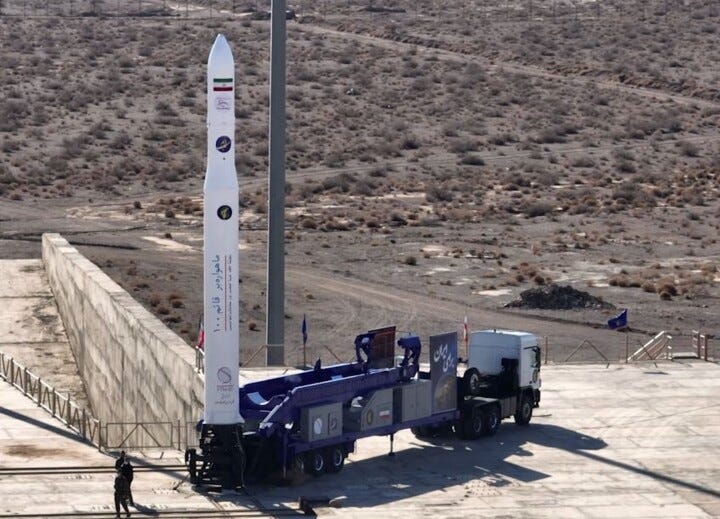
Arguably, the most consequential element of Iran’s hedging strategy for developing longer-range systems has been the IRGC’s space programme. Satellite launch vehicles (SLVs) and long-range ballistic missiles share many of the same underlying technologies. In practice, however, many launch vehicles are optimised for placing satellites into orbit and are poorly suited to conversion into ballistic missiles. The IRGC’s programme has followed a markedly different path, emphasising compact, road-mobile, solid-propellant SLVs that could provide the technological basis for longer-range missile systems. These design choices, coupled with repeated allusions by IRGC officials, leave little doubt that the programme has also served as a long-range missile hedging effort.
The programme’s ultimate objective is the planned Ghaem-120, an SLV intended to place a satellite into geostationary orbit and likely to provide the technological basis for any future Iranian ICBM development. By 2026, this objective had not been achieved. Iran had, however, successfully developed two intermediate systems that could potentially be converted into missiles with ranges exceeding 2,000 km. These included the Qased launcher, which combines a liquid-propellant first stage derived from the Ghadr ballistic missile with newly developed solid-propellant upper stages, and the all-solid-propellant Ghaem-100.
Iran’s parallel regular space programme also developed a compact solid-propellant SLV, the Zuljanah. Israeli assessments suggest that, if converted into a ballistic missile, the system could achieve a range of approximately 5,000 km. The SLV’s development has, however, faced technical difficulties, and the system has so far failed to place a satellite into orbit.
Out in the Open
By October 2025, an Iranian parliamentarian claimed that Khamenei had lifted the restrictions on Iran’s missile range. The timing and rationale behind the decision remain unclear, although the E3’s activation of the snapback mechanism in August may have played a role.
During the subsequent 2026 conflict, Iran employed missiles with ranges beyond 2,000 km for the first time. On 20 March, Iran launched two intermediate-range ballistic missiles (IRBMs) at Diego Garcia, approximately 3,900 kilometres from Iran’s southern coast. One missile reportedly failed in flight, while the other was engaged exo-atmospherically by an SM-3 interceptor, although it remained unclear whether the interception was successful.
Although Iranian officials have alluded to the strike, neither Iran nor the United States has released detailed information on the attack or the systems involved. Israel’s chief of staff described the weapon used as a two-stage missile, which, if accurate, would suggest either the conversion of a space-launch vehicle or a further development of the Khorramshahr missile family.
After the Diego Garcia strike, additional Iranian officials eventually acknowledged that the limit was no longer in place. It remains unknown whether Iran, drawing on its hedging effort, rapidly adapted an existing system after Khamenei’s abrogation of the limit or whether Iran had secretly developed such capabilities while the limit was still formally in place.
Operational Constraints
While the 2026 conflict demonstrated that Iran possesses an operational IRBM capability, the threat these systems currently pose to Europe is constrained by several factors. Iran’s IRBM inventory is almost certainly significantly smaller than its short- and medium-range missile arsenal, while the capability itself may not yet be fully mature. Iranian IRBMs are also unlikely to be equipped with mature terminal-guidance systems, making them relatively inaccurate at longer ranges. Although Iran may retain the ability to assemble additional missiles from stored components, US strikes against key missile-production facilities as well as the broader supply chain have very likely, at least temporarily, halted its ability to produce new missiles.
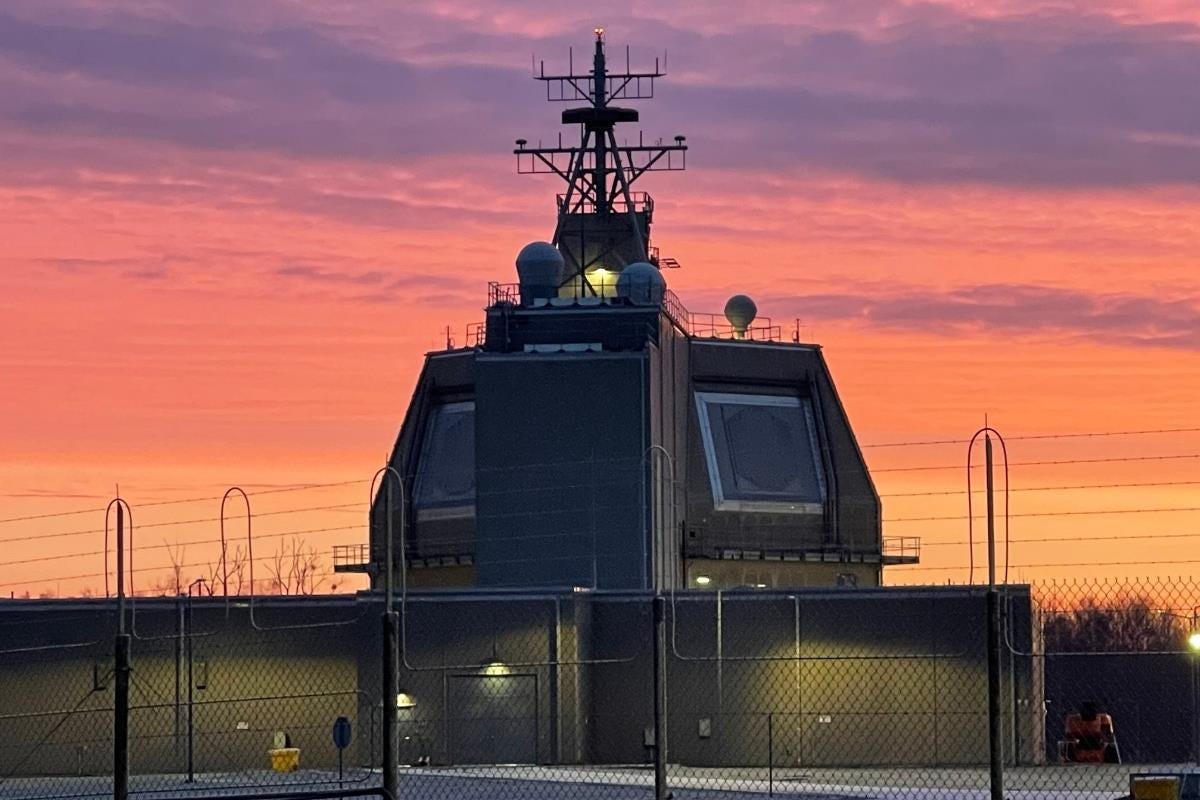
Any Iranian IRBM attack against continental Europe would also have to contend with existing exo-atmospheric missile-defence capabilities. The US Aegis Ashore sites in Poland and Romania were established specifically to defend against a limited Iranian IRBM attack and could be further reinforced by SM-3-equipped US Navy vessels in European waters. Germany, for its part, is in the process of fielding the Israeli-made Arrow 3 system. Although the system is reportedly serving in an early-warning role for now, it will eventually be capable of intercepting Iranian IRBMs.
That said, these constraints should not be overstated. A limited Iranian IRBM attack against Western Europe would likely be intended primarily to generate political and psychological effects, which could be achieved even by an extremely limited strike with insignificant kinetic effects.
Outlook
Iran currently possesses a mature ballistic-missile arsenal capable of targeting southeastern Europe, alongside a probably small and not yet fully mature IRBM force capable of reaching Central and Western Europe. However, changes in Iran’s leadership following the killing of Ali Khamenei mean that the nature and scale of this threat will likely continue to evolve.
Although Khamenei presided over a highly radical regime, he himself often appeared to be a cautious and reluctant decision-maker. His approach to security policy seems to have centred on middle-ground solutions intended to accommodate various factions within the regime while limiting the risks and personal responsibility associated with more decisive alternatives. In capability development, this was evident in Iran’s nuclear and long-range missile hedging and, one might argue, in its approach to chemical and biological weapons. Operationally, it was reflected in Iran’s response to the post-7 October security environment. Tehran eventually launched direct attacks against Israel in 2024 but stopped short of conducting a sustained campaign. A similar middle-ground-posture was evident during the Twelve-Day War, when Iran began striking Israeli cities but refrained from activating its most powerful leverage by attacking regional shipping and energy infrastructure.
This wider approach, which has dominated Iranian security policy for decades, might have come to an end. Not only is its principal architect no longer alive, but regime elites are also likely to have interpreted the events of the past two years as evidence of its abject failure. Rather than minimising risk, Khamenei’s middle-ground solutions often appear to have maximised it by combining the worst of both worlds.
Iran’s capability hedging was insufficient to placate Western nations, incurred sanctions and, in the nuclear case, invited military attack. At the same time, it left Iran without deployed capabilities that could have truly strengthened deterrence. In the operational realm, the regime’s limited actions normalised direct military confrontation between Iran and its adversaries but failed to maintain or re-establish Iranian deterrence, thereby seemingly inviting the next round of attack.
Iran’s new leadership will have to internally renegotiate the central tenets of Iranian security policy. While a return to the Khamenei-era approach, more comprehensive restraint or a stronger propensity for radical solutions could all emerge from this process, the ascendancy of the IRGC and the lessons learned from the post-2023 conflict might favour the latter.
Thus, as Iran will undoubtedly move to reconstitute its military capabilities, Europe might face an Iran that is not only less reluctant to develop systems capable of threatening Western Europe, but also less hesitant to use them.
In the first paragraph: "following a Ukrainian long-range drone strike against a vessel in the Caspian Sea reportedly carrying arms to Ukraine"
It should probably be "carrying arms to Russia" right?
I wonder if the Iranian leadership is so incompetent that it doesn't understand that the last thing it needs right now is to waste resources on such "uselessness" as attacks against Europe.